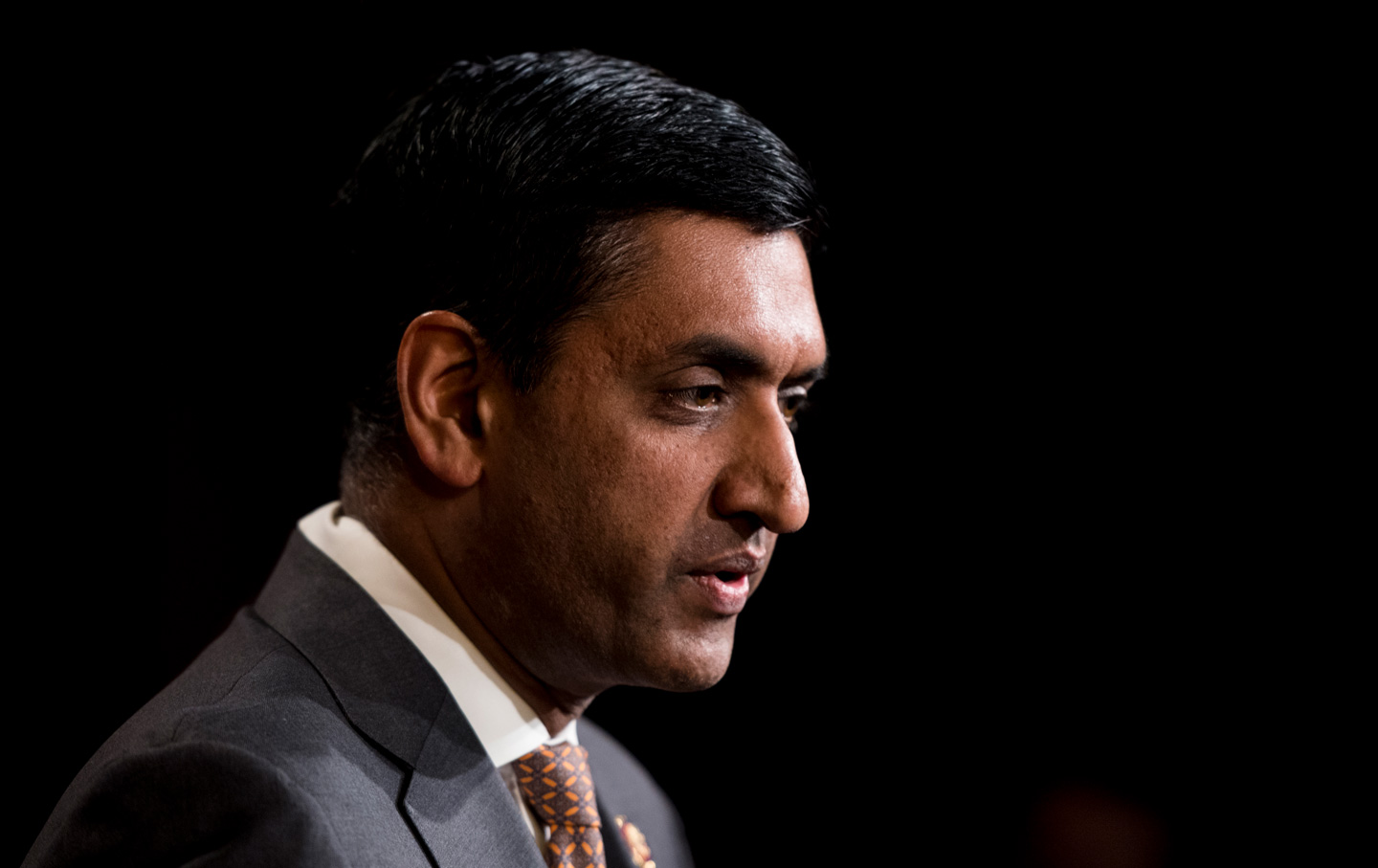
” We aren’t an island. I suggest, the illness is going to continue to return to us,” stated the agent from California.
Ro Khanna, the vibrant progressive United States agent from California, was influenced to go into politics by the tradition of his grandpa, Amarnath Vidyalankar (1901–1985), the famous Indian trade unionist, self-reliance advocate, and parliamentarian. He was born and raised in the United States, Khanna took a trip regularly to India as a youth, and he speaks movingly of how “our household’s worths come from my grandpa’s accept of a Gandhian worldview”– in specific, Mahatma Gandhi’s belief “in the oneness not of simply all human life however in the oneness of all that lives.”
In current weeks, as India has actually been ravaged by a coronavirus break out that has actually seen record-breaking levels of infection and death, Khanna has actually become a supporter for worldwide interventions to combat the rise– detailing techniques for the United States to send out protective equipment, oxygen, and vaccines, and leading the charge to get President Joe Biden’s assistance to have the World Trade Company authorize a Trade-Related Elements of Copyright Rights (JOURNEYS) waiver so that India and other nations can produce Covid-19 vaccines. After the Biden administration signified that it would support the waiver of copyright securities, alleviating patent limitations on the production of life-saving vaccines, I consulted with Khanna about the essential battle to get vaccines to India.
There are a number of things that failed. One, a total neglect for social distancing, and this concept of going back to regular [before widespread vaccination programs could be implemented], which undoubtedly was a catastrophe.
2nd, an absence of having the capability on vaccines. Partially, that was due to the fact that the JOURNEYS waiver must have been approved months previously. There need to have been more of a worldwide production dedication. The last administration [under former president Donald Trump] not did anything on that. There need to have been a higher effort in basic, in these nations, to help them with the advancement of the vaccine.
Third, I believe this has actually exposed the failures of the Indian healthcare system. The healthcare system has a long method to go to have the ability to look after the requirements of individuals in crisis, and it reveals the huge requirement for advancement.
JN: Let’s concentrate on the vaccine problem. Plainly, we must have been believing a year back, as vaccines were being established, about how to get this minute. Why, when the United States and other nations plainly understood this was a worldwide crisis, wasn’t it?
RK: One concern is the “America initially” diplomacy. There was no regard for what [the pandemic] implies for the remainder of the world.
Here it is essential to identify an accountable and eventually self-centered issue for individuals in other parts of the world from a rootless cosmopolitanism. Nobody is stating that we were incorrect to focus on Americans or to prioritize our neighborhoods. That’s completely suitable. Countries must do that.
What was completely shortsighted, ethically incorrect, and absurd is that there was no factor to consider after we prioritized our own country of what we were going to do and what our duty was to the remainder of the world.
We aren’t an island. I indicate, the illness is going to continue to return to us.
We might have taken some really easy procedures. We might have stated, “We have a license for the vaccine”– indicating other nations spend for it, other nations compensate Pfizer or Moderna–” however we’re going to a minimum of license the vaccine formula.” We might have established an international production fund so that other nations would be making the vaccine without injuring our supply.
None of that was done. As an effect, there are countless individuals passing away worldwide who should not be and we’re at much higher danger, due to the fact that all these variations are returning into the United States, making it harder for us to surpass the illness.
JN: You think that President Biden did the ideal thing, that the administration did the ideal thing, with their welcome of the JOURNEYS waiver.
RK: I would state they did more than the best thing. They did the bold thing. This was a hard choice.
JN: How so?
RK: I heard it from Silicon Valley. The quantity of individuals stating, “I’m dissatisfied. I’m never ever going to support you on a waiver on IP [intellectual property] law.” The lobby for IP security in this nation surpasses the pharmaceutical market.
There are a great deal of individuals in service who see that as the Holy Grail, something untouchable. They think that you do not water down IP rights. And I make certain, if I was dealing with that as a member of Congress, that should have been a hundredth of what the president was dealing with.
My understanding, having actually talked with individuals in the administration, is that a great deal of individuals in the administration understood that this was the ethically best thing to do and they were defending that, and I provide credit, especially individuals who were stating this is the ideal thing from a diplomacy point of view.
On the other side were all of the political forces, and a few of it was hardball politics. Who understands what was stated? [it’s likely there were expressions of] an issue that we require these pharmaceutical business to do boosters for our country, and we require them to continue to disperse to Americans and are they going to play hardball [when it comes to] doing what President Biden acknowledges as the very first top priority, which is taking care of the American individuals?
That, I believe, was truly the strength of the political pressure. For President Biden to make this choice, I believe we should provide him credit.
This president has actually done a great deal of things that are more progressive than I believed we would see from him, which I’m thankful about. There are 2 locations in specific where I would state he has actually revealed remarkable nerve: One, on Afghanistan, he has actually overthrown his generals, actually the facility. 2, on this JOURNEY waiver, where he needed to handle a great deal of effective financial interests.
JN: You were a particularly outspoken supporter on this concern, however you weren’t alone. The push for the waiver was enhanced by advocacy groups and members of Congress in the days prior to Biden proceeded it.
RK: Yes. Let me inform you, when I was running for Congress, I would constantly make the case that representation matters. When I was running, there was no Indian American in Congress aside from [California Democrat] Ami Bera. At the exact same time that I ran, [Illinois Democrat] Raja Krishnamoorthi was running, [Washington Democrat] Pramila Jayapal was running, and all of us ran the project stating representation matters.
That to me was theoretical at that time. This was the very first time I felt, “Wow, representation matters,” since when this [surge of Covid-19 cases in India] was happening, Raja and myself and Pramila were on CNN, on the Home flooring, in touch with the administration to state, “We have actually got to do something,” not due to the fact that we have actually any increased ethical sense, however since we were hearing it firsthand.
You understand, as a member of Congress, you’re overloaded. You have actually got a hundred various instructions. On this, we were hearing it from constituent after constituent, how dreadful it was, and I do believe that voice made a distinction.
JN: Are you pleased with the administration’s action? With Secretary of State Antony Blinken’s reaction? Exists more that requires to be done?
RK: To the president’s credit, and to Secretary Blinken’s credit, they set in motion within a week. Their action on getting oxygen in was excellent. Their reaction on getting PPE in was great. Secretary Blinken was assembling day-to-day calls with all of these tech leaders seeing how we can activate our economic sector. That was excellent. And after that this JOURNEY choice has actually been, like I stated, brave.
So they have actually done a lot right, and they have actually done a lot well, and I believe it’s going to deepen the India-US relationship. This is India’s time of requirement, and President Biden and Blinken have actually been there for the nation in a huge method.
The only thing I believe, moving forward, that I ‘d like for them to continue to deal with is assisting with the international production capability. The waiver is necessary, however unless we really help not simply India however a hundred other nations with the production ability and the technical support, it’s not going to scale.
JN: You spoke a minute ago about representation mattering. You have household ties to India. You have actually talked to me typically about your grandpa’s tradition. Speak to me about your own sense of connection with India and how that affects you in this minute.
RK: It’s on an individual level in a really instant sense. Simply the other day, a cousin of mine texted that my daddy’s cousin had actually died. I had not seen that individual for 25 years, however it restored a flood of memories of when I would go to India as a kid and satisfied him.
My aunties and cousins are still there. There’s still this sense that this is impacting a great deal of individuals who were, at least, near my moms and dads, and individuals whom I had actually fulfilled.
Then there’s a much deeper connection with my grandpa, since he actually is the motivation behind my desire to enter into civil service. He is somebody who invested 4 years in prison in the 1940 s in Gandhi’s “Quit India” motion, who enters into India’s very first parliament, who is a supporter for human rights and a supporter for pluralism and a supporter for democracy and tolerance.
Those worths are ones that assisted form me and form the important things that I think are best and simply. That in part provides me a sense of desiring to see an India that is real to those Gandhian perfects– and certainly, that hasn’t been the case in a number of circumstances. More than that, it provides me a sense of desiring to constantly be happy of that spiritual structure, as I continue my public service profession.
I’ll end with this, since it’s on my mind. I read just recently “The Composite Country,” by Frederick Douglass. Among the important things that I discovered so moving about [that speech] is that Douglass views America, at its finest, as this abundant composite of deep customs and motions from worldwide. I believe that for me, the motion my grandpa belonged to is something that I think can improve, as part of the contribution to, the American whole– what Douglass calls the “composite country.”.
It’s taken me a very long time to get to that point personally, since I was so happy– I am so happy– of being American, so happy with all of the customs. And yet to see that my heritage, my grandpa’s story, my ties to India, are ingredients to the American story, part of the American story, I believe that becomes part of what makes me able to make a special contribution.


No comments:
Post a Comment