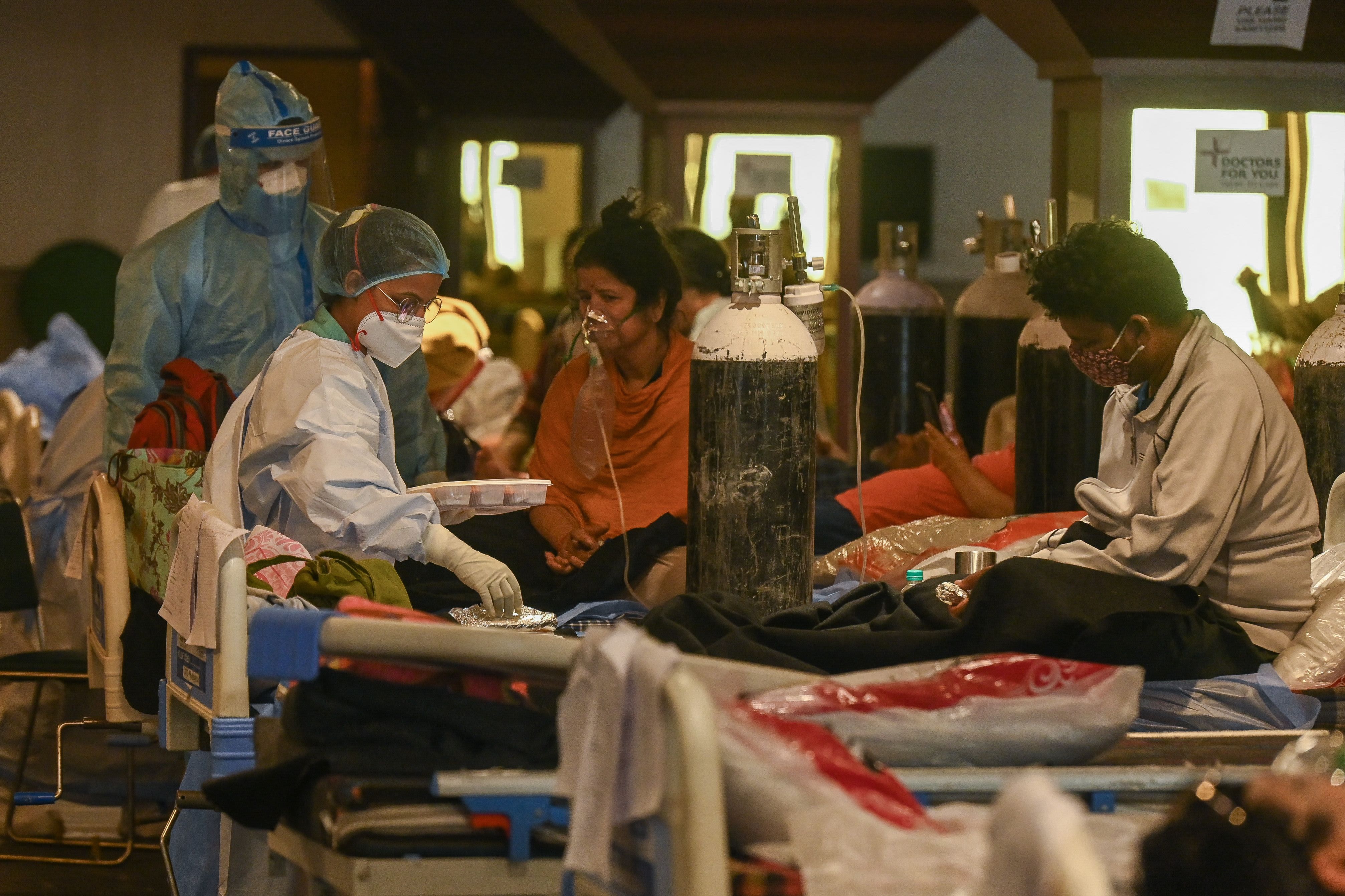
India is facing a terrible 2nd wave of coronavirus that’s much more deadly than the very first– and researchers state the rise might be partly due to altering stress.
The World Health Company simply reclassified the B. 1.617 stress, which was initially recognized in India, as a “variation of issue”– a sign that the version has the “greatest public health ramifications.”
The health firm stated the choice was made due to the fact that the version appears to have greater rates of transmission, and initial proof recommend “prospective decreased efficiency” of an antibody utilized in Covid-19 treatment. The variation likewise has “possibly a little lowered vulnerability” to neutralization antibodies, the WHO stated in its weekly upgrade.
India is the world’s 2nd worst hit nation, reporting more than 22.66 million infections and more than 246,000 deaths to date, information from India’s health ministry reveals. Specialists state the numbers are most likely significantly underreported as numerous never ever make it to the medical facilities which have actually lacked beds and oxygen.
What do we understand?
The earliest samples of the B. 1.617 were discovered in India in October, and authorities revealed in March this year that the variation had actually ended up being more typical in the state of Maharashtra.
The World Health Company stated Monday that it is reclassifying the stress as a “version of issue.” It was formerly called a “version of interest,” which is a lower level of alert.
Dr. Maria Van Kerkhove, Covid-19 technical lead at the WHO, stated there is details recommending that B. 1.617 has actually “increased transmissibility” and “some lowered neutralization.”
A relative brings a client who is having trouble in breathing, to a totally free oxygen assistance centre being run by a Gurudwara, a location of praise for Sikhs in the middle of Covid-19 coronavirus pandemic on the borders of New Delhi on Might 10, 2021.
Arun Sankar|AFP|Getty Images
Versions of issue are more infectious, trigger more serious illness or lower the efficiency of public health steps, vaccines or medication, according to the UN health company.
” We do not have anything to recommend that our diagnostics, our rehabs and our vaccines do not work,” she stated at a media rundown on Monday.
Other versions of issue consist of the B. 1.1.7 which was initially recognized in the UK, and the B. 1.351 which was found in South Africa.
The limit for figuring out a variation of interest is reasonably low compared to the category of a version of issue, the WHO stated.
According to Gisaid, a platform where nations can share information on infections, the B. 1.617 stress from India has actually been identified in about 40 nations, consisting of the U.S., U.K. and Singapore.
Did it activate India’s 2nd wave?
There are numerous elements that resulted in the sharp spike in India’s Covid-19 cases– and altering versions is simply among them.
The WHO stated several variations distributing in India are showing increased transmissibility, however the B. 1.617 stress has a “considerably greater development rate.”
We turned our back on the infection, however the infection did not turn its back on us. And now we are paying the cost.
K Srinath Reddy
president, Public Health Structure of India
B. 1.617 has 3 sub-lineages, each with somewhat various anomalies, WHO stated. As cases in India saw a “significant rise,” the B. 1.6171 and B. 1.6172 family trees have actually ended up being more common, the health company stated.
The variation has actually in some cases been described as a “double mutant” since it brings 2 anomalies– the E484 Q and L452 R– that might make the infection more infectious and much better at averting the body’s defenses. A 3rd anomaly in the variation, the P681 R, can possibly result in “improved transmission,” the WHO stated.
Virologists who talked to CNBC stated the terms “double anomaly” or “triple anomaly” are not clinically precise. Reports stated the B. 1.617 has more than a lots anomalies.
In its upgrade, the WHO indicated “a number of spiritual and political mass event occasions which increased social blending” in India, and highlighted the underuse or lowered adherence to public health and social steps.
” The precise contributions of these each of these elements on increased transmission in India are not well comprehended,” it included.
K Srinath Reddy, president of the general public Health Structure of India, stated there was a prevalent belief that the pandemic was over “permanently” in January.
” It appeared that the policymakers, the market, along with the general public, were nervous to return to regular life, put the economy back on rails, and actually overlooked the hazard that was still there,” he informed CNBC’s “Capital Connection” recently.
” As I stated, we turned our back on the infection, however the infection did not turn its back on us. And now we are paying the rate,” Reddy stated.
Do vaccines work?
BioNTech CEO Ugur Sahin informed CNBC last month he is “positive” the business’s vaccine, which was established together with U.S. drugmaker Pfizer, works versus the variation from India.
” We had comparable double mutants in our previous screening, and we are positive based upon the information we had in the past that we may see a comparable style of neutralization of this infection,” he stated, though BioNTech did not have enough information on B. 1.617 at that point.
The WHO stated initial lab research studies discovered that 28 receivers of Covaxin had the ability to reduce the effects of the B. 1.617 version. Covaxin is a vaccine established by India’s Bharat Biotech and the state-run Indian Council of Medical Research Study.
Numerous research studies have actually likewise been done utilizing antibodies produced by other vaccines and some recommend a restricted decrease in neutralization, which might imply that vaccines might be less reliable However the WHO stated “real-world effects might be restricted.”
” Prospective effects of B. 1.617 family tree on efficiency of vaccines or therapies, or reinfection dangers, stay unpredictable,” it stated.
Former White Home health policy director Dr. Kavita Patel stated the existing vaccines have “some efficiency,” however that there have actually been “development infections” by the B. 1.617 version.
” We’re really worried. This is precisely the sort of established for what we call ‘leave resistance’– where the variation is so worrying and the body’s body immune system can’t battle it,” she informed CNBC’s “Squawk Box Asia” recently.
— CNBC’s Saheli Roy Choudhury and Berkeley Lovelace Jr. added to this report.
Explanation: This story has actually been modified to clarify the attribution mentioning that the B. 1.617 has more than a lots anomalies.
This story has actually been upgraded to consist of the World Health Company’s updates on the B. 1.167 in its weekly upgrade on May 11, 2021.


No comments:
Post a Comment